
Jun
LIVE - Rebellion Reads Posts
Tattoo Needle Types Explained | Tattoo Equipment Evolution Pt. 2
Tattoo needle types fall into two core categories: liners for crisp outlines and shaders for fills. Configurations include Round Liner, Round Shader, Magnum, and Curved Magnum — each built with a specific gauge, taper, and grouping that determines line quality, shading, and healed results.
Understanding Tattoo Needle Types
Tattoo needles are the foundation of every tattoo. Over time, they evolved from sharpened bone and stone tools to handcrafted steel and, eventually, today’s precision cartridges. While tattoo machines may have stolen the spotlight in Part 1, the truth is that it’s the needle that defines line quality, shading, and artistry. Tattoo needle types—also called tattoo needle categories—each carry a distinct feature and technique they’re designed to execute. In this guide, we’ll break down tattoo needle types, their history, and their configurations—so you can see the craft behind every line and shade.
New to REBEL?
Use code FIRST20 at checkout and get 20% off your first order.
The Origins Of Tattoo Needles
Long before steel, tattoo artists used sharpened bone, stone, or wood tools to puncture the skin and carry pigment. Consequently, these early tools required great skill and patience.
When steel became available, everything changed. Artists now had consistency, sharper tips, and the ability to group needles into specialized configurations. As a result, modern cartridge systems represent the pinnacle of that evolution: safer, more hygienic, and precision-built for pro tattooing.
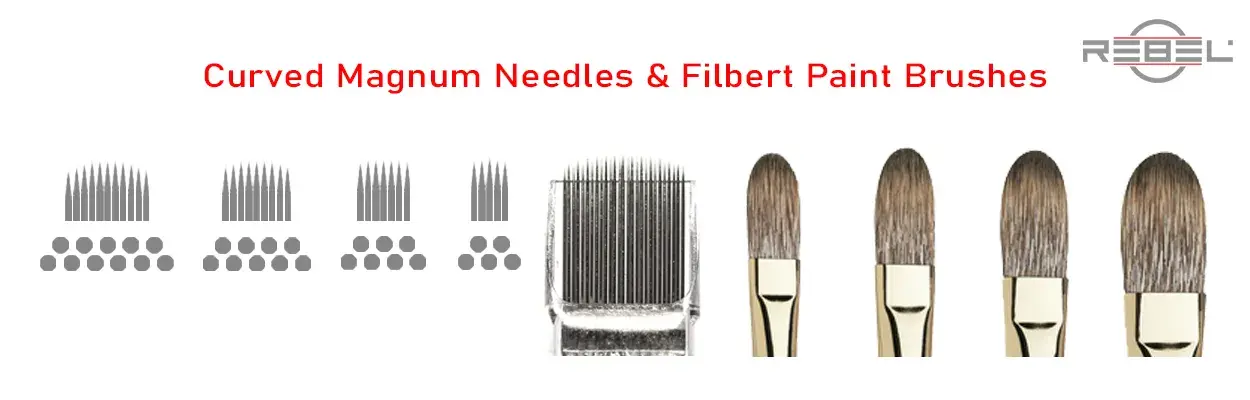
Brushes And Needles – An Artist’s Analogy
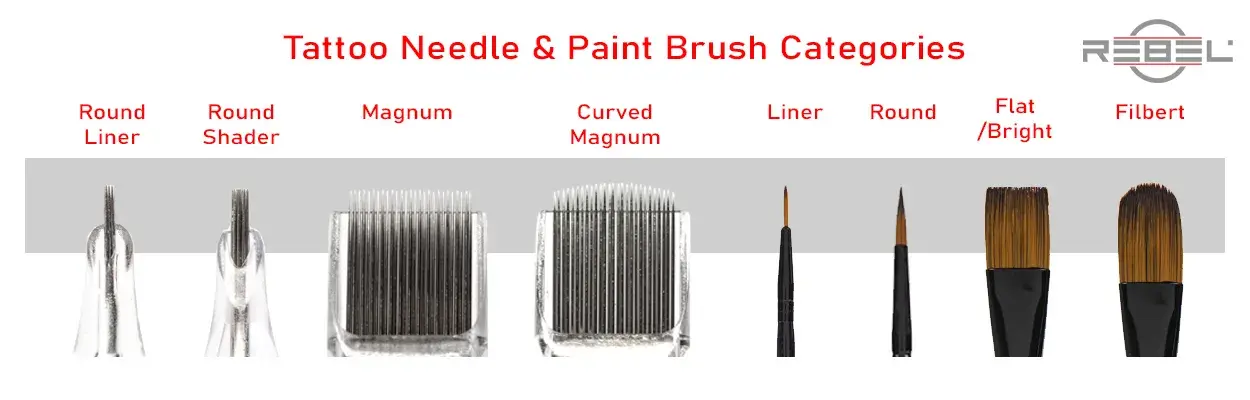
In other words, tattoo needles are like a painter’s toolkit:
- Liner = fine liner brush
- Round Shader = round brush
- Magnum = flat/bright brush
- Curved Magnum = filbert brush
This analogy helps artists translate canvas techniques onto skin.
This graphic shows how Round Liner, Round Shader, Magnum, and Curved Magnum needles relate to different paint brushes.
Tattoo Needle Types
We distinguish two main tattoo needle types based on their primary functions. On the one hand, liners are built for outlines. Meanwhile, shaders are designed for filling and shading.
1. Liner Tattoo Needle Configurations
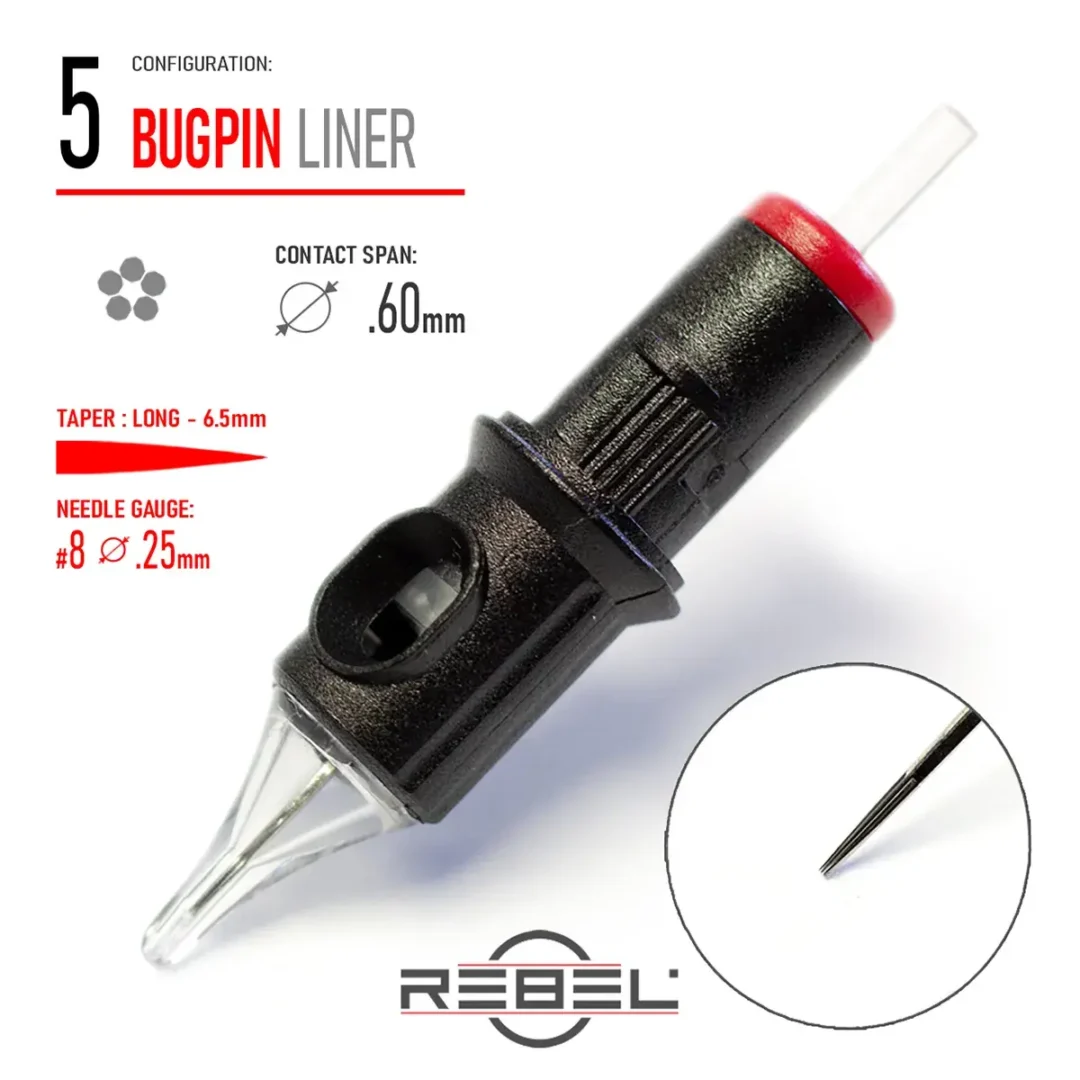
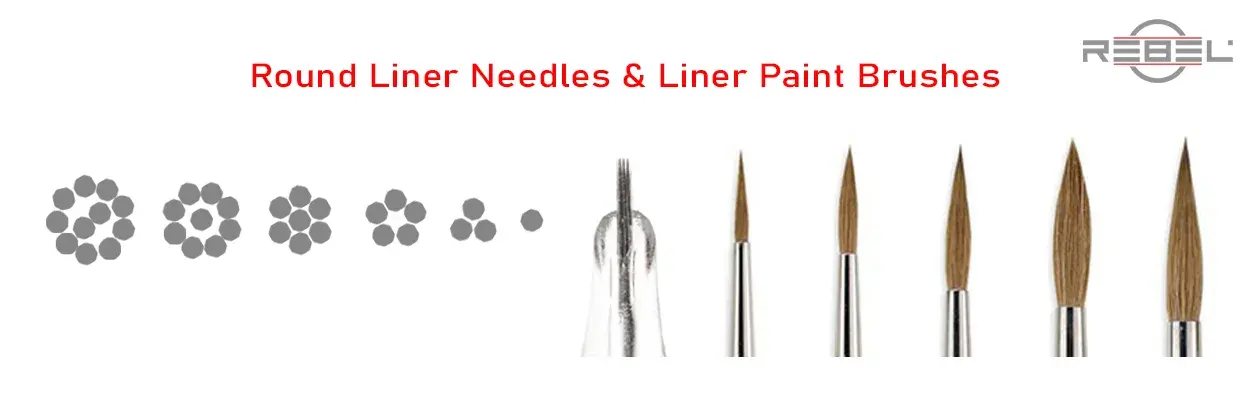
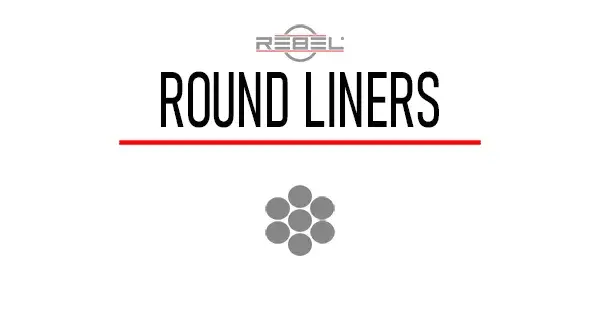
- Round Liner Needles – Liners are designed for crisp, sharp lines. In fact, they are the backbone of outlines, detail work, and scripts.
2. Shader Tattoo Needle Configurations
Shaders fill and shade, delivering smooth gradients and solid color saturation. Within this category, there are three main subtypes:
2.1 Round Shader Needle Configurations
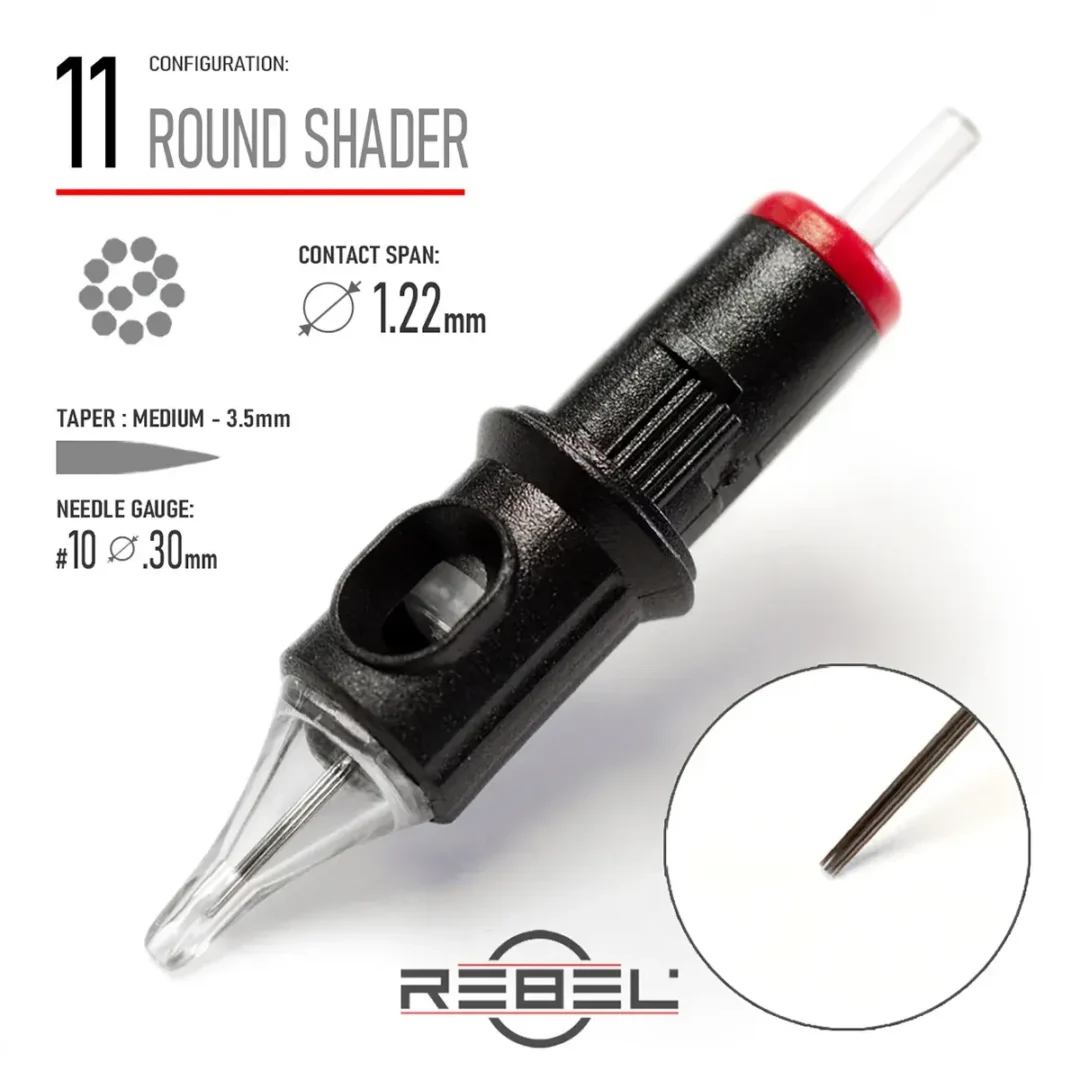
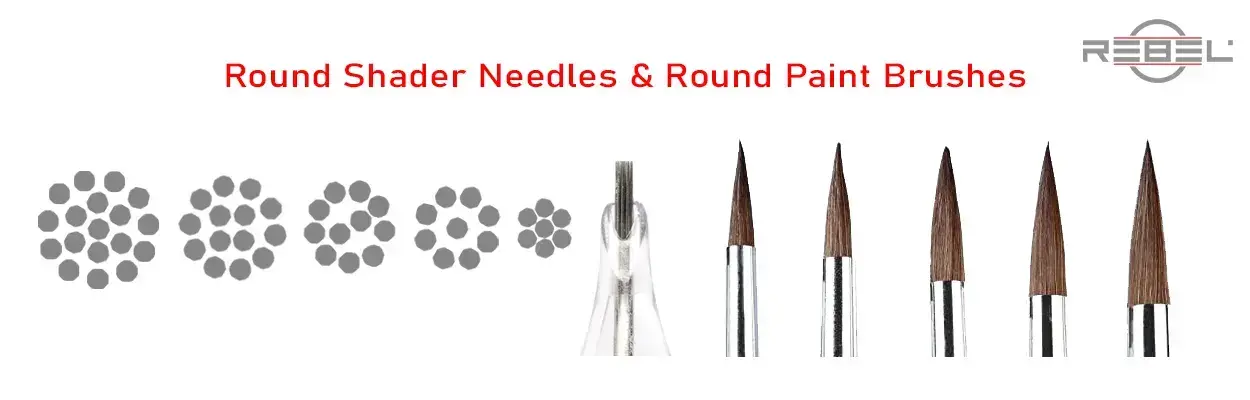
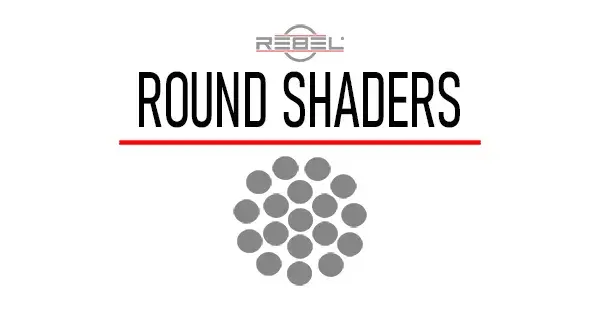
Round Shader Needles – for soft fills and blending.
2.2 Magnum Tattoo Needle Configurations
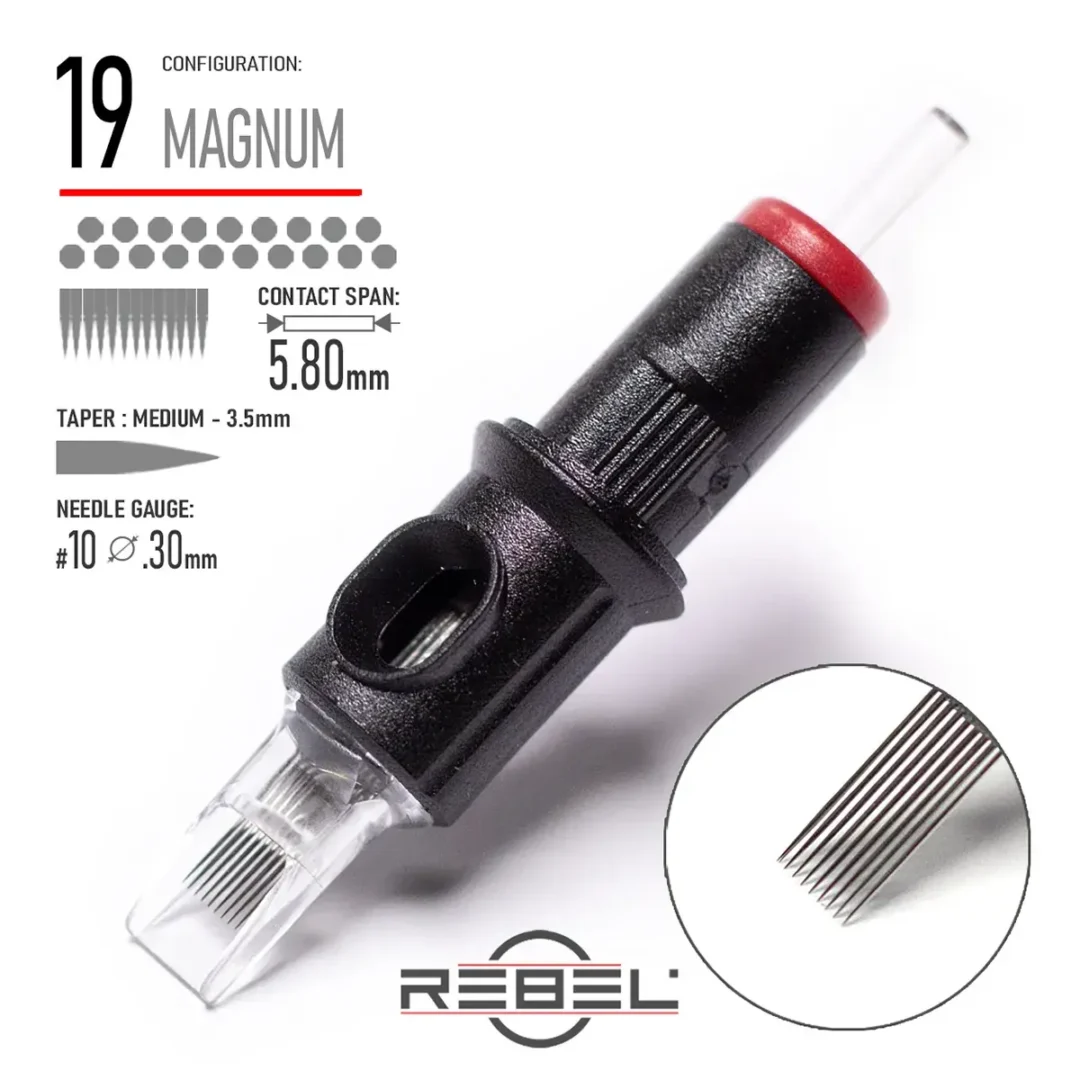
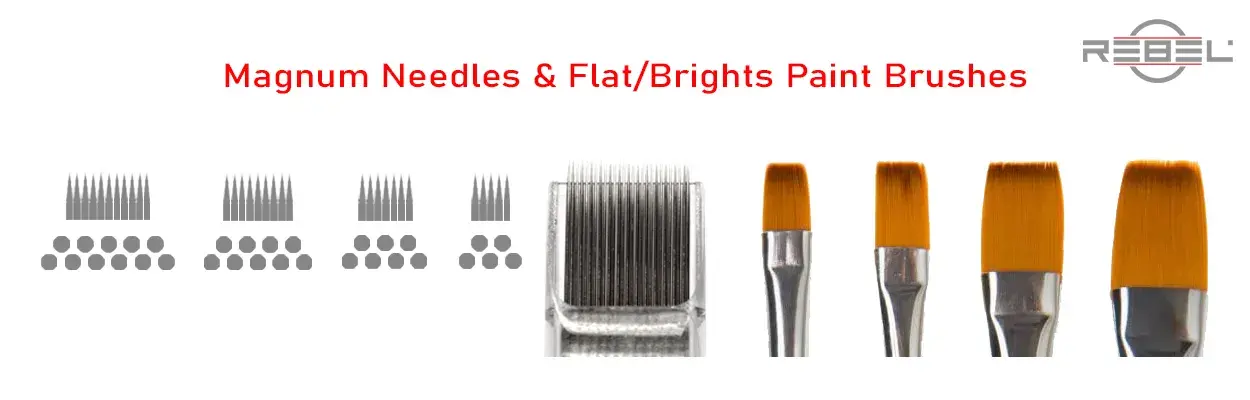
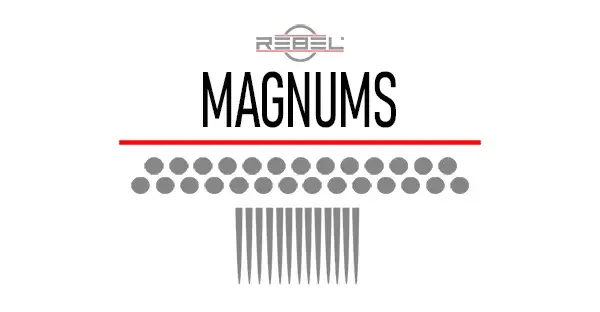
Magnum Shader Needles – flat groupings for bold shading and color packing.
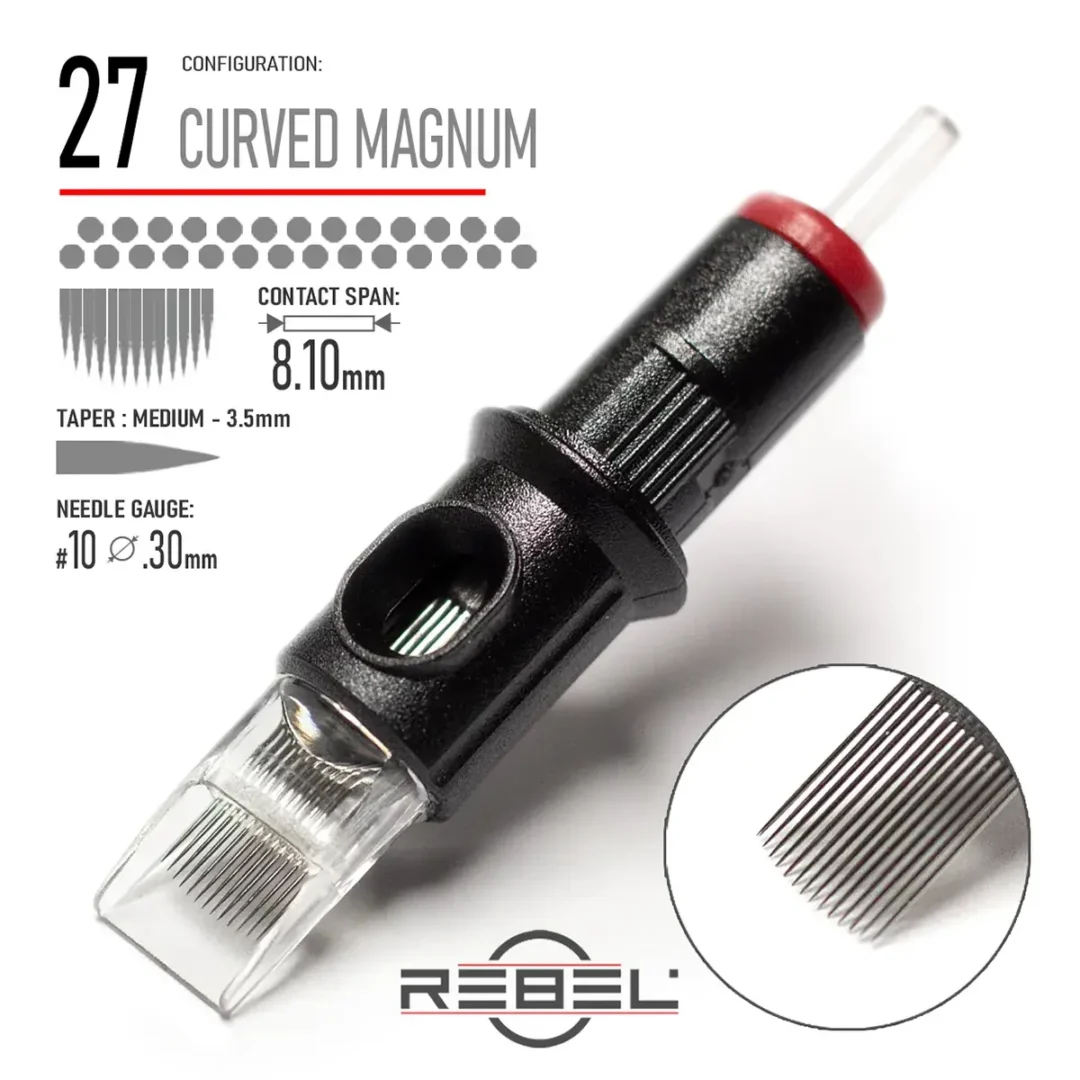
2.3 Curved Magnum Needle Configurations
Curved Magnum Shader Needles – slightly arched for softer edges and smoother gradients.
Diameters Or Gauges Of Stainless-Steel Wires
Tattoo needles are manufactured from stainless-steel wires in three standard gauges. Specifically:
- #8 (.25mm) – Fine
- #10 (.30mm) – Normal
- #12 (.35mm) – Fat
In practice, tattoo needles made from thicker wires deliver thicker, bolder lines, while thinner wires allow finer detail. Therefore, artists must choose the right gauge for the task at hand. Consequently, the most commonly used diameter is #10 (.30mm), which offers an ideal balance between the two.
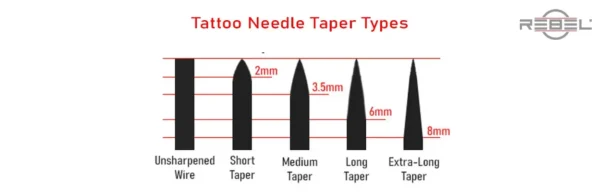
What Do We Know About Tapers?
Simply put, taper is how long the needle is sharpened from body to tip.
- Short taper (.07” / 2mm) – thick, bold ink delivery.
- Medium taper (.14” / 3.5mm) – balanced and versatile.
- Long taper (.23” / 6.5mm) – finer detail and softer penetration.
- Extra-long taper (.31” / 8mm) – tight groupings for precision, often used in bugpin liners.
For example, short tapers cannot be grouped into a tight point, whereas long tapers allow closer groupings, resulting in finer lines. Therefore, choosing the right taper is just as important as selecting the correct gauge and configuration.
Tattoo Needle Configurations
Tattoo artists used to group needles by soldering them into bars. Today, however, manufacturers provide them ready to use in modern cartridges. The number of needles and their arrangement defines the configuration:
- Round Liner (RL) – tightly grouped for precise outlines.
- Round Shader (RS) – grouped slightly wider for smoother fills.
- Magnum (M/MG) – two equal-length flat rows for shading and color packing.
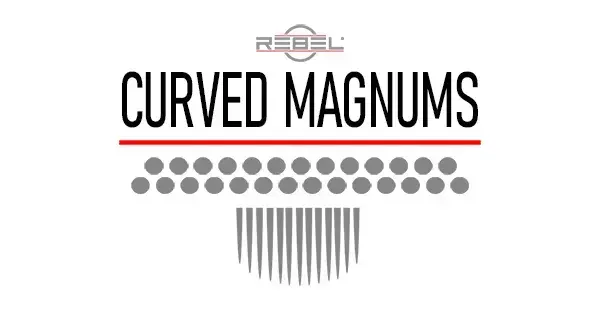
- Curved Magnum (CM) – two slightly arched rows for softer blends.
The industry identifies configurations with numbers plus type, such as 9RL, 15M, or 27CM. Each configuration can be made with different gauges and tapers, so the market offers a wide range of options. Not understanding these variations can leave an artist struggling to achieve the intended final tattoo results.
Why It Matters
Understanding tattoo needle types helps you choose the right needle for the desired outcome, because each type has its unique features. For instance, you can’t make precise lines with magnum configurations, and you can’t shade effectively with liner needles. In addition, this knowledge helps you control ink, depth, and flow according to your intended result. Without it, in fact, achieving consistent healed results is nearly impossible. However, when you match the right needle to the right technique, your work becomes cleaner, visually more satisfying, and longer-lasting. Scientific research on tattoo needles.
Frequently Asked Questions
Tattoo needles fall into two categories: liners, grouped tightly for crisp outlines, and shaders — including Round Shader, Magnum, and Curved Magnum — built for fills, blending, and color packing.
Round Liners group needles tightly for sharp, precise lines. Round Shaders space them slightly wider, delivering softer fills and smoother blending instead of a hard outline.
#10 (.30mm) is the industry standard, balancing bold ink delivery with control. #8 (.25mm) suits fine detail work; #12 (.35mm) delivers thicker, bolder lines.
Conclusion
Tattoo machines may have modernized the process, but needles are the true heart of tattooing. From ancient bone tips to today’s precision cartridges, overall, every evolution has been about control, safety, and artistry.
Why REBEL Precision Cartridges Define The Standard
Every spec in this guide — gauge, taper, configuration — is engineered into REBEL Precision Cartridges from the first weld. Round Liner, Round Shader, Magnum, and Curved Magnum are built to exact contact-span and taper tolerances, so the needle theory above translates directly into cleaner lines, smoother shading, and consistent healed results on every professional setup.
Explore
For artists ready to work with modern systems, explore the full range of REBEL Precision Cartridges — designed for safety, consistency, and efficiency.
Read On
From here, continue with Liner Tattoo Needle Configuration – Part 3 of the Tattoo Equipment Evolution Series. You can read back on Part 1 – Tattoo Needle History or browse all posts in Rebellion Reads.
Spread The Knowledge
If this article gave you clarity, share it with fellow tattoo artists and apprentices. The more we understand how our tools are built, the higher we can set the standards of tattooing.
Make Your Voice Heard By Leaving A Comment
Got questions or insights about today’s topic? Drop them in the comments — your voice helps push the craft forward.
When you understand your needle type, every stroke becomes predictable — and predictability is precision.

